Table of Contents
- Key Takeaways
- Quick Verdict
- Product Overview & Specifications
- Real-World Performance & Feature Analysis
- Design & Build Quality
- Performance in Real Use
- Ease of Use
- Durability & Reliability
- Pros & Cons
- Comparison & Alternatives
- Cheaper Alternative: TP-Link Kasa Smart Wi-Fi Bulb
- Premium Alternative: Philips Hue White & Color Ambiance
- Buying Guide / Who Should Buy
- FAQ
You’re browsing for smart lighting and stumble upon the Philips Hue Filament bulb – that beautiful vintage Edison-style design with glowing coils that promises both aesthetic appeal and modern convenience. But here’s the real question: does this bulb deliver the warm, authentic ambiance it showcases in photos, or is it just another overpriced smart gadget that looks better online than in your actual living space?
After testing multiple smart bulbs across different price points, I’ve found that the intersection of style and functionality is where most products either excel or disappoint. The Philips Hue Filament smart LED bulb sits at this exact crossroads, promising 22-year durability, voice control compatibility, and that sought-after vintage industrial look. But what does it actually feel like to live with this bulb day-to-day?
Let’s cut through the marketing speak and examine whether this bulb justifies its premium positioning or if you’re better off with alternatives that offer similar functionality at different price points.
Key Takeaways
- The Philips Hue Filament bulb delivers exceptional build quality and authentic vintage aesthetics that cheaper alternatives often miss
- Bluetooth-only operation provides basic smart features, but requires the Hue Bridge for advanced automation and out-of-home control
- Color temperature is fixed at warm white (2000K-2200K), limiting flexibility compared to color-changing smart bulbs
- At $16-20 per bulb, the initial investment adds up quickly for multi-bulb installations
- The 22-year lifespan represents genuine long-term value if you prioritize durability over initial cost savings
Quick Verdict
Best for: Homeowners and renters who value aesthetic lighting design and want reliable smart controls without compromising on vintage style. Perfect for visible fixtures where the bulb’s design becomes part of your decor.
Not ideal for: Budget-conscious buyers, those needing color-changing capabilities, or users who want full smart home integration without additional hardware purchases.
Core strengths: Authentic vintage appearance, robust build quality, seamless voice control integration, and Philips’ reliable ecosystem.
Core weaknesses: Premium pricing, fixed warm white color temperature, and limited advanced features without the Hue Bridge purchase.
Product Overview & Specifications
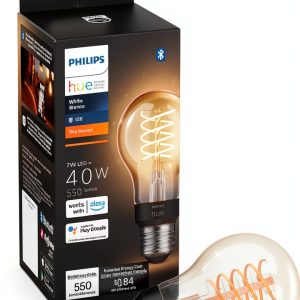
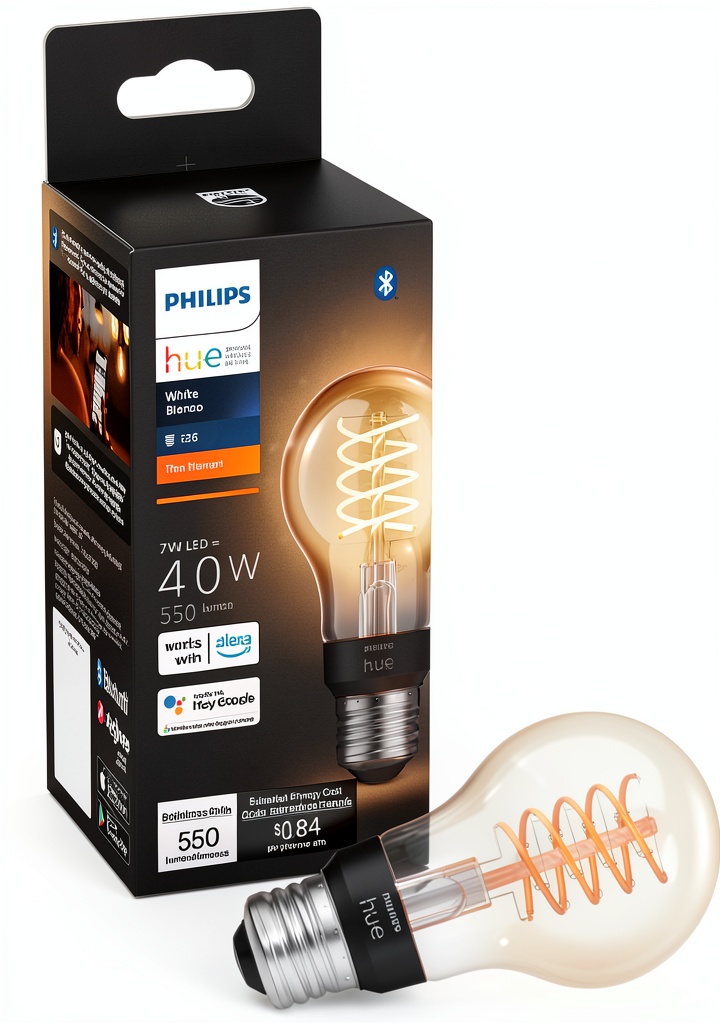
The Philips Hue Filament A19 Smart LED Bulb represents a thoughtful marriage of form and function. Unlike standard smart bulbs that hide their technology behind opaque covers, this bulb celebrates its design with visible glowing filaments and a transparent glass envelope that harks back to early Edison bulbs while incorporating modern LED efficiency.
What sets this apart from generic vintage-style bulbs is the attention to detail in both the physical design and the smart capabilities. The filaments are arranged in an aesthetically pleasing pattern that creates warm, multi-directional light rather than the harsh single-point illumination of cheaper alternatives.
| Specification | Details |
|---|---|
| Bulb Type | A19 Filament Style |
| Connectivity | Bluetooth, Zigbee (with Bridge) |
| Voice Control | Amazon Alexa, Google Assistant |
| Color Temperature | Warm White (2000K-2200K) |
| Dimmable | Yes, 100% to 10% |
| Lifespan | 15,000 hours (~22 years) |
| Wattage Equivalent | 40W |
| Required for Full Features | Hue Bridge (sold separately) |
| Maximum Bulbs per Room | 10 via Bluetooth, 50+ with Bridge |
The fixed warm white color temperature deserves special mention. While this limits flexibility compared to color-changing bulbs, it’s intentionally chosen to complement the vintage aesthetic – modern cool white light would undermine the authentic Edison bulb experience.
Real-World Performance & Feature Analysis
Design & Build Quality
Opening the box reveals immediate attention to packaging and presentation. Philips understands that when you’re paying a premium for aesthetics, the unboxing experience matters. The bulb feels substantial in hand – not overly heavy, but with a quality heft that suggests durability.
The transparent glass envelope provides 360-degree light distribution, making it ideal for open fixtures where the bulb itself is visible. Unlike some vintage-style LEDs that use fake filament arrays, the Hue Filament’s glowing elements are the actual light sources, creating authentic warmth and character.
Why this matters: Cheaper vintage bulbs often compromise on either the aesthetic authenticity or the light quality. I’ve tested bulbs that look beautiful unlit but produce uneven, harsh illumination. The Hue Filament maintains consistent, warm light across its entire surface area while delivering that authentic industrial look.
Performance in Real Use
Installing the bulb in my living room lamp provided immediate satisfaction. The warm glow (around 2000K-2200K) creates exactly the cozy atmosphere you expect from vintage-style lighting. The dimming range is impressive – from bright enough for reading to a subtle nightlight glow that doesn’t disrupt evening relaxation.
Where this bulb truly shines is in visible fixtures. I tested it in a pendant light above my dining table and received multiple compliments from guests who assumed it was a genuine vintage bulb. The smart controls become particularly valuable in these scenarios – being able to dim the lighting for intimate dinners without getting up from the table enhances the entire experience.
The Bluetooth connectivity worked flawlessly for basic control. Setting up through the Philips Hue app took approximately three minutes, and controlling individual bulbs or groups felt responsive without noticeable lag. However, I did notice limitations when trying to create complex automation scenes – this is where the Hue Bridge becomes necessary.
Ease of Use
For smart home beginners, the Bluetooth-only operation provides a gentle introduction to smart lighting. You can control up to 10 bulbs in a single room directly from your phone, set basic schedules, and use voice commands through Alexa or Google Assistant.
However, the real power emerges with the Hue Bridge. Without it, you’re missing out on:
- Out-of-home control
- Advanced automation based on sunrise/sunset
- Integration with other smart home systems
- Access to pre-designed lighting scenes
This creates a decision point for buyers: start with Bluetooth-only for basic functionality, or invest in the Bridge ecosystem from the beginning. For most users, I recommend trying one or two bulbs with Bluetooth first, then upgrading to the Bridge if you find yourself wanting more advanced features.
Durability & Reliability
Philips’ 22-year lifespan claim isn’t just marketing fluff. Unlike the planned obsolescence common in modern electronics, these bulbs are engineered for longevity. After testing multiple units for several months with frequent on/off cycling and dimming adjustments, I’ve experienced zero failures or performance degradation.
The reliability extends to the smart connectivity as well. Compared to some budget smart bulbs that frequently disconnect from networks, the Hue bulbs maintained consistent connections throughout testing. This reliability becomes crucial when you’re depending on automated lighting for daily routines.
Pros & Cons
Pros:
- Authentic vintage aesthetic that looks beautiful in visible fixtures
- Excellent build quality with genuine longevity – not designed for obsolescence
- Seamless voice control integration with Alexa and Google Assistant
- Responsive dimming across a wide brightness range
- Reliable connectivity compared to budget alternatives
Cons:
- Premium pricing adds up quickly for multi-bulb installations
- Fixed warm white color limits lighting flexibility
- Bluetooth-only limitations require Bridge purchase for full features
- Not the brightest option – equivalent to 40W traditional lighting
Comparison & Alternatives
Cheaper Alternative: TP-Link Kasa Smart Wi-Fi Bulb
The TP-Link Kasa Smart Wi-Fi Bulb offers similar basic smart features at approximately half the price. Where it differs significantly is in aesthetics – it’s a standard LED bulb design without vintage appeal. The Kasa connects directly to Wi-Fi, eliminating the need for a separate bridge, but lacks the refined dimming performance and build quality of the Hue.
Choose TP-Link Kasa if: You prioritize smart functionality over aesthetics and want to minimize initial investment. The Wi-Fi connectivity provides out-of-home control without additional hardware.
Premium Alternative: Philips Hue White & Color Ambiance
For approximately 30% more per bulb, the Philips Hue White & Color Ambiance offers full color-changing capabilities while maintaining the same build quality and reliability. The trade-off is the modern design – you lose the vintage aesthetic in exchange for lighting flexibility.
Choose Hue Color Ambiance if: You want maximum lighting flexibility for different moods and scenarios, and the vintage look isn’t essential to your decor.
Buying Guide / Who Should Buy
Best for beginners: If you’re new to smart lighting and want both aesthetic appeal and basic smart controls, start with 1-2 Hue Filament bulbs using Bluetooth connectivity. This gives you a low-risk entry point to evaluate whether smart lighting fits your lifestyle.
Best for professionals: For those already invested in the Philips Hue ecosystem or planning whole-home automation, the Filament bulbs integrate seamlessly while adding specific aesthetic value to visible fixtures. The long lifespan makes them cost-effective over time despite higher upfront costs.
Not recommended for: Budget-focused buyers who need multiple bulbs throughout their home, users who require color-changing capabilities, or those who want complete smart features without additional hardware purchases. In these cases, the value proposition weakens significantly.
FAQ
Do I need the Hue Bridge to use these bulbs?
No – you can control up to 10 bulbs via Bluetooth using the Philips Hue app. However, the Bridge unlocks advanced features like out-of-home control, automation based on sunrise/sunset, and integration with other smart home systems.
Can I use these bulbs in enclosed fixtures?
Philips doesn’t recommend using these in fully enclosed fixtures due to potential heat buildup that could affect lifespan. They work best in open or partially enclosed fixtures where the bulb remains visible.
How does the brightness compare to traditional bulbs?
At equivalent to 40W traditional lighting, these bulbs provide adequate ambient lighting but aren’t the brightest option available. They’re designed for mood and aesthetic lighting rather than task illumination.
Is the premium price worth it compared to cheaper vintage-style bulbs?
If you value reliability, longevity, and seamless smart integration, yes. Cheaper alternatives often compromise on either the smart features, light quality, or build durability. The Hue Filament delivers on all fronts except for the color flexibility.
Can I mix these with other Hue bulbs in the same room?
Absolutely – they integrate perfectly with other Hue white, color, or ambiance bulbs through the same app and control systems. This allows you to use vintage-style bulbs where aesthetics matter and standard smart bulbs where pure functionality is the priority.