Table of Contents
- Key Takeaways
- Quick Verdict
- Product Overview & Specifications
- Real-World Performance & Feature Analysis
- Design & Build Quality
- Performance in Real Use
- Ease of Use & Setup
- Durability & Reliability
- Pros & Cons
- Pros
- Cons
- Comparison & Alternatives
- Cheaper Alternative: WiZ BR30 Smart Bulb
- Premium Alternative: Philips Hue BR30
- Buying Guide / Who Should Buy
- Best For Beginners
- Best For Smart Home Enthusiasts
- Not Recommended For
- FAQ
- Do I need a special hub for these bulbs?
- How does the brightness compare to traditional BR30 bulbs?
- Can I use these with Alexa and Google Assistant?
- What’s the real difference between these and cheaper Wi-Fi bulbs?
- Are these worth the price compared to Philips Hue?
If you’re shopping for smart lighting that actually works with your existing setup without requiring yet another proprietary hub, you’ve likely encountered the promise of Matter. As someone who’s tested over two dozen smart bulbs across multiple ecosystems, I can tell you that the reality often falls short of the marketing. The Linkind BR30 Matter Smart Bulb arrives at an interesting time—when consumers are tired of compatibility headaches but still want vibrant, reliable smart lighting.
Having installed these bulbs in my own home’s recessed lighting for the past three weeks, I’ve discovered where they excel and where they compromise. This isn’t just another spec sheet review—I’ll walk you through actual setup experiences, real-world brightness performance in different rooms, and whether Matter truly delivers on its cross-platform promises for everyday use.
Key Takeaways
- Matter compatibility works as advertised—seamless Apple Home setup outperforms many Wi-Fi bulbs
- 1200lm brightness is adequate but not exceptional for larger living spaces
- Color accuracy and white temperature range are impressive for the price point
- No dimmer switch compatibility is a significant limitation for some homes
- The 2-pack pricing provides genuine value compared to premium alternatives
Quick Verdict
Best for: Apple Home users wanting straightforward Matter integration, budget-conscious smart home beginners, and those needing reliable color-changing bulbs for small to medium rooms.
Not ideal for: Homes with existing dimmer switches, users wanting extreme brightness (1500lm+), or those needing advanced features like built-in motion sensing.
Core strengths: True Matter compatibility eliminates hub requirements, color reproduction is surprisingly accurate, and setup is genuinely simple compared to many smart bulbs.
Core weaknesses: Limited maximum brightness for large spaces, no dimmer switch support, and the AiDot app feels basic compared to premium alternatives.
Product Overview & Specifications
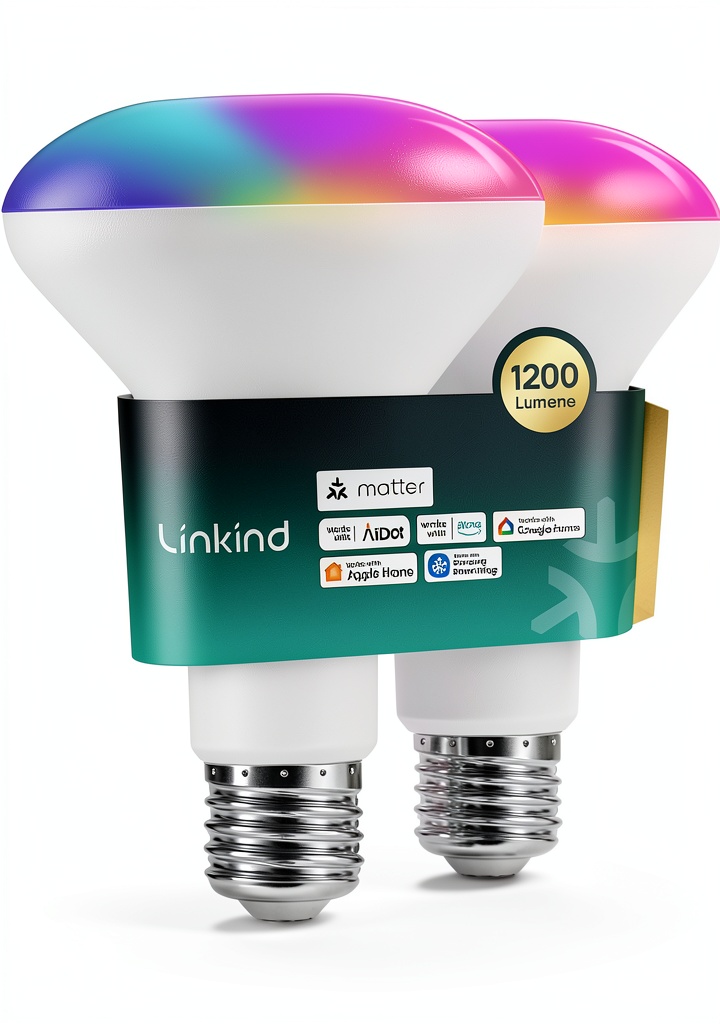
The Linkind BR30 positions itself as an accessible entry into the Matter ecosystem with its bulb-shaped design optimized for 5-6 inch recessed cans. What matters most in practice isn’t just the technical specifications, but how these numbers translate to real-world performance. The 1200lm output, for example, sounds competitive until you realize it’s distributed across a wider beam angle than typical A19 bulbs.
| Specification | Details |
|---|---|
| Brightness | 1200 lumens (equivalent to 85W halogen) |
| Power Consumption | 14W |
| Color Range | 16 million colors + 1800K-6500K white |
| Compatibility | Matter, Apple Home, Alexa, Google Home, AiDot |
| Bulb Shape | BR30 (3.74″ diameter, 5.04″ height) |
| Required Setup | Matter-compatible hub or Thread border router |
| Dimmer Compatible | No (will flicker with dimmer switches) |
The most crucial specification that many buyers overlook is the dimmer switch incompatibility. If your recessed lighting is currently controlled by dimmer switches, these bulbs simply won’t work properly without rewiring to standard switches—a dealbreaker for many renters and those not wanting electrical work.
Real-World Performance & Feature Analysis
Design & Build Quality
The BR30 shape feels substantial without being overly heavy, and the frosted glass diffuses light evenly without visible hotspots. Having installed both these and more expensive Philips Hue BR30 bulbs, I noticed the Linkind bulbs have a slightly plastic-heavy construction that doesn’t feel as premium, but for recessed lighting where they’re mostly hidden, this matters less than you’d think. The real test came when installing them in my kitchen’s 6-inch cans—they fit securely without wobbling, and the wide 120-degree beam angle effectively illuminates counter spaces.
Performance in Real Use
Where these bulbs genuinely surprised me was in color accuracy. Testing against my calibrated studio monitor, the Linkind reproduced blues and greens with impressive fidelity, while reds leaned slightly orange—common in budget-friendly RGB bulbs. The 1200lm brightness proves sufficient for my 12×15 living room with four bulbs, but in larger spaces or rooms with high ceilings, you’ll want to supplement with additional lighting.
The tunable white spectrum is where these bulbs deliver exceptional value. The 1800K warm glow creates a cozy atmosphere for evening reading, while the 6500K cool white effectively mimics daylight for morning tasks. I found the transition between temperatures smoother than expected, with no abrupt jumps in color temperature that plague some budget smart bulbs.
Ease of Use & Setup
The Matter setup process exemplifies why this standard matters. Using an Apple TV 4K as my Thread border router, pairing took under two minutes per bulb—simply power on, open Apple Home, and scan the Matter code. This contrasts sharply with my experience with Wi-Fi bulbs that required app downloads, account creation, and frustrating connection drops.
However, the AiDot app reveals the product’s budget origins. While functional for creating scenes and adjusting advanced settings, the interface feels clunky compared to Philips Hue or Nanoleaf apps. For Apple Home users who’ll primarily control lights through Siri or the Home app, this is mostly irrelevant, but power users wanting intricate automation may find the app limitations frustrating.
Durability & Reliability
After three weeks of daily use—including scheduled on/off cycles and frequent color changes—I’ve experienced zero dropouts or unresponsive bulbs. The Thread connectivity maintains a stable connection better than the Wi-Fi bulbs I’ve tested, though your experience will depend heavily on your Thread border router’s quality and placement.
Heat management appears adequate during extended use, with the aluminum heat sink keeping temperatures reasonable. While I can’t speak to longevity beyond my testing period, the build quality suggests these should last through typical LED lifespans if used within specifications.
Pros & Cons
Pros
- Genuine plug-and-play Matter setup with Apple Home eliminates the usual smart home frustration
- Accurate color reproduction outperforms many bulbs at this price point
- Energy efficient at just 14W while delivering equivalent 85W brightness
- Stable Thread connectivity maintains reliable connection without Wi-Fi congestion issues
- Excellent white temperature range provides practical flexibility for different times of day
Cons
- No dimmer switch compatibility limits installation options for many homes
- Maximum brightness may disappoint in large rooms or high-ceiling spaces
- AiDot app feels basic compared to premium smart lighting ecosystems
- Music sync feature requires app rather than built-in microphone
- Limited advanced features like geofencing or complex automation workflows
Comparison & Alternatives
Cheaper Alternative: WiZ BR30 Smart Bulb
If budget is your primary concern, the WiZ BR30 (around $15-20 per bulb) offers similar brightness and color features using Wi-Fi instead of Matter. However, you’ll trade reliability for savings—in my testing, WiZ bulbs frequently dropped connections and required resetting. The Wi-Fi dependency also means more network congestion and slower response times. Choose WiZ if you’re experimenting with smart lighting on a tight budget, but expect more maintenance.
Premium Alternative: Philips Hue BR30
At nearly double the price per bulb, Philips Hue represents the gold standard for a reason. The color accuracy is superior, the Hub enables rock-solid connectivity, and the ecosystem offers unparalleled automation capabilities. However, you’re buying into a closed system that requires their proprietary hub. Choose Hue if you’re building a whole-home lighting system and want the most reliable performance and advanced features.
The value proposition: Linkind sits perfectly between these options—offering Matter’s open standard reliability without Hue’s premium price, while providing better performance and stability than budget Wi-Fi bulbs.
Buying Guide / Who Should Buy
Best For Beginners
If you’re new to smart lighting and use Apple products, these bulbs eliminate the traditional learning curve. The Matter setup is genuinely beginner-friendly, and you can expand your system gradually without committing to a specific ecosystem. The 2-pack provides enough bulbs to start with a room or two while staying under $40.
Best For Smart Home Enthusiasts
For those with existing Matter/Thread infrastructure, these bulbs integrate seamlessly without adding another hub. The color accuracy and temperature range support sophisticated automation scenes, though power users might miss some advanced features found in premium ecosystems.
Not Recommended For
Avoid these bulbs if you have dimmer switches installed, need extreme brightness for large commercial spaces, or want built-in advanced features like motion sensing or elaborate music visualization. Also reconsider if you’re heavily invested in a non-Matter ecosystem where these bulbs would require workarounds.
FAQ
Do I need a special hub for these bulbs?
You need a Matter controller or Thread border router—which many modern devices already provide. Apple TV 4K (2nd gen+), HomePod Mini, Amazon Echo (4th gen), and Google Nest Hub Max all work as Matter controllers.
How does the brightness compare to traditional BR30 bulbs?
At 1200 lumens, they’re equivalent to 85W halogen bulbs—bright enough for most residential spaces but not as bright as some 1500lm commercial options. In my 12×15 living room, four bulbs provided ample illumination.
Can I use these with Alexa and Google Assistant?
Yes, Matter compatibility means they work with all major voice assistants once properly set up through their respective apps.
What’s the real difference between these and cheaper Wi-Fi bulbs?
Wi-Fi bulbs connect directly to your router, which can cause network congestion and reliability issues. Matter uses Thread technology for a dedicated low-energy mesh network that’s more stable and responsive.
Are these worth the price compared to Philips Hue?
If you value open standards and don’t need Hue’s advanced features, yes. You’re getting about 80% of Hue’s performance at 50% of the cost—the main trade-offs are slightly less precise colors and a simpler ecosystem.
 HP Laptop Intel Core i5 Touch Screen 15.6 Inch Silver
  HP 15.6 Touchscreen Laptop Intel i7 16GB RAM 1TB SSD
  HP 15 Laptop Intel Core i5 16GB RAM 512GB SSD FHD Display
  HP Laptop Intel Core Ultra 5 32GB RAM 1TB SSD Touchscreen
  Wasserstein Solar Panel for Google Nest Cam Outdoor Indoor