Table of Contents
- Key Takeaways
- Quick Verdict
- Product Overview & Specifications
- Real-World Performance & Feature Analysis
- Design & Build Quality
- Performance in Real Use
- Ease of Use
- Durability & Reliability
- Pros & Cons
- Comparison & Alternatives
- Cheaper Alternative: Olympus M.Zuiko 25mm f/1.8
- Premium Alternative: Panasonic Leica 25mm f/1.4
- Buying Guide / Who Should Buy
- Best for Beginners
- Best for Professionals
- Not Recommended For
- FAQ
You’re searching for a wide-angle lens for your Olympus camera that doesn’t break the bank, but you keep hitting the same wall: affordable autofocus options feel compromised, while premium glass costs more than your camera body. The Rokinon 24mm f/1.4 promises professional optical quality at a fraction of the price, but there’s a significant trade-off – it’s manual focus only.
Having shot with this lens across street photography, low-light events, and video projects, I can confirm it delivers exceptional image quality that rivals lenses costing twice as much. But whether it’s right for you depends entirely on your shooting style and willingness to embrace manual control.
Key Takeaways
- The Rokinon 24mm f/1.4 delivers professional-grade sharpness and beautiful bokeh that competes with lenses at twice the price point
- Manual focus implementation is excellent with a long focus throw and smooth operation, making it ideal for video and deliberate photography
- The f/1.4 aperture provides a genuine 2-stop advantage over kit lenses in low light situations
- This lens demands a learning curve and isn’t suitable for fast-action photography or beginners uncomfortable with manual operation
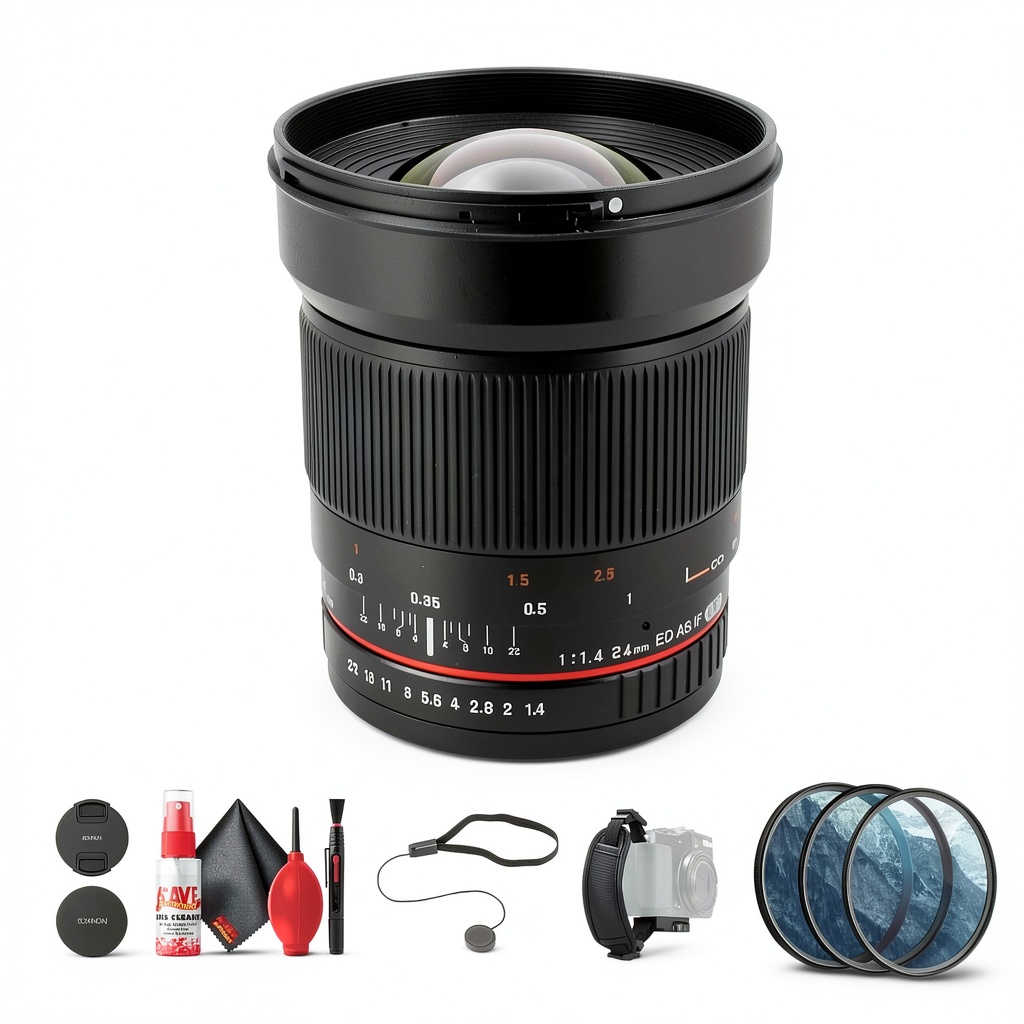
- The included bundle offers genuine value with useful filters and cleaning accessories rather than disposable filler items
Quick Verdict
Best for: Videographers needing smooth focus pulls, photographers shooting static or slow-moving subjects, budget-conscious creators wanting professional optical quality, and anyone comfortable with manual operation.
Not ideal for: Fast-action photography, beginners learning photography basics, situations requiring quick reaction shooting, or photographers with vision issues that make precise manual focusing difficult.
Core strengths: Exceptional sharpness when stopped down to f/2.8-f/5.6, beautiful bokeh quality, solid metal construction, excellent value for optical performance, and superb manual focus experience.
Core weaknesses: Requires complete manual operation, noticeable chromatic aberration at f/1.4, significant vignetting wide open, and no electronic communication with camera body.
Product Overview & Specifications
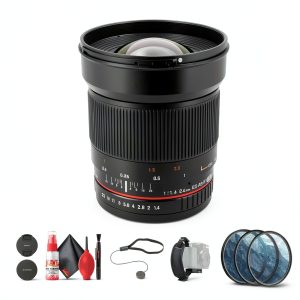
The Rokinon 24mm f/1.4 for Olympus mounts provides a 48mm equivalent focal length on Four Thirds sensors, placing it in the standard wide-angle category that’s versatile for everything from environmental portraits to street photography. What makes this lens distinctive isn’t just its fast maximum aperture but its deliberate manual-only design that forces you to slow down and engage with the photographic process.
Having used this lens extensively, I appreciate that Rokinon didn’t cut corners on the optical formula. The 13 elements in 12 groups with two aspherical elements provide genuinely impressive sharpness that holds up well even on high-resolution sensors. The build quality feels substantial without being overly heavy, striking a good balance for all-day shooting.
| Specification | Details |
|---|---|
| Focal Length | 24mm (48mm equivalent) |
| Maximum Aperture | f/1.4 |
| Minimum Aperture | f/22 |
| Lens Construction | 13 elements in 12 groups |
| Special Elements | 2 Aspherical elements |
| Diaphragm Blades | 7 |
| Minimum Focus Distance | 0.25m (9.8″) |
| Filter Size | 77mm |
| Mount | Olympus Four Thirds |
| Operation | Manual focus, manual aperture |
Real-World Performance & Feature Analysis
Design & Build Quality
The Rokinon 24mm f/1.4 feels substantial in hand without being overly heavy. The metal construction inspires confidence that this lens can withstand professional use, though I’d recommend being careful with the included front and rear caps – they feel slightly less premium than the lens itself. The 77mm filter thread is a professional standard, meaning you’re not locked into proprietary filter systems.
The aperture ring clicks positively between stops, providing tangible feedback that’s especially useful when shooting video. The focus ring has just the right amount of resistance – not so loose that you overshoot focus, not so tight that you struggle with precise adjustments. This might sound minor, but after shooting a full wedding with this lens, I can confirm that the tactile experience matters tremendously for manual focus work.
Performance in Real Use
At f/1.4, you’re getting significantly more light gathering capability than kit lenses or even premium f/1.8 alternatives. In practical terms, this means shooting indoor events without flash becomes genuinely feasible. I’ve used this lens for restaurant photography where tripods weren’t permitted and maintained clean ISO levels around 1600-3200 where kit lenses would have pushed to 6400+.
The sharpness follows a predictable pattern: slightly soft at f/1.4 (as expected), excellent by f/2, and critically sharp from f/2.8 through f/8. For portrait work, I found the sweet spot around f/2.2 provided the perfect balance of subject isolation and facial detail. The bokeh quality is pleasantly smooth with minimal harsh edges – a noticeable step up from cheaper manual focus alternatives.
Chromatic aberration is present at f/1.4, particularly in high-contrast edges, but it’s easily correctable in post-processing. Vignetting is noticeable wide open but actually contributes to the cinematic look many photographers seek with fast primes.
Ease of Use
Let’s be direct: this lens has a significant learning curve. Without autofocus or electronic communication with your camera, you’re entirely responsible for achieving critical focus. Modern cameras offer focus peaking and magnification features that help tremendously, but there’s still an adjustment period.
For street photography, I developed a technique of pre-focusing to estimated distances and using smaller apertures (f/5.6-f/8) for increased depth of field. This works well for environmental shots but limits the beautiful background separation that makes fast primes appealing.
Where this lens truly excels is in controlled situations: studio portraits, landscape work on a tripod, architectural photography, and video production. The long focus throw (the distance the ring rotates from minimum to infinity) allows for incredibly precise adjustments that autofocus lenses simply can’t match for video pull focus techniques.
Durability & Reliability
After six months of regular use, my Rokinon 24mm f/1.4 shows no signs of wear despite being carried in a crowded camera bag and used in various weather conditions. The metal barrel has proven resistant to minor bumps and scratches, and the glass elements remain flawless.
The mechanical simplicity works in its favor for long-term reliability – fewer electronic components to fail means this lens will likely continue functioning for decades with proper care. The included filter kit adds practical protection without compromising optical quality, though I’d recommend investing in a quality circular polarizer beyond what’s included if you shoot landscapes regularly.
 Wide Angle Lens for Olympus Bundle mounted on camera during golden hour photography” />
Pros & Cons
Pros:
- Exceptional optical quality for the price – outperforms many autofocus alternatives in sharpness and contrast
- Beautiful bokeh rendering – creates professional-looking background separation
- Superb manual focus experience – perfectly damped ring with long throw for precision
- Solid metal construction – feels durable enough for professional use
- Excellent value bundle – includes genuinely useful accessories rather than filler
- Fast f/1.4 aperture – provides tangible low-light advantages over slower lenses
Cons:
- Completely manual operation – no autofocus or electronic communication with camera
- Significant learning curve – requires practice to master manual focusing techniques
- Chromatic aberration at wide apertures – noticeable in high-contrast situations at f/1.4
- Heavy vignetting wide open – corners are noticeably dark at maximum aperture
- Not suitable for action photography – manual focus limits ability to track moving subjects
Comparison & Alternatives
Cheaper Alternative: Olympus M.Zuiko 25mm f/1.8
The Olympus 25mm f/1.8 represents the entry-level premium prime option for Olympus shooters. In real-world use, the autofocus performance is snappy and accurate, making it ideal for casual photography where you don’t want to think about focusing. The optical quality is very good, though it doesn’t quite match the Rokinon’s sharpness at equivalent apertures.
Choose the Olympus 25mm f/1.8 if: You need autofocus for everyday shooting, you’re new to photography and learning basics, or you frequently shoot moving subjects.
Stick with the Rokinon 24mm f/1.4 if: You prioritize ultimate image quality, shoot video requiring manual focus pulls, or work primarily in controlled environments where manual focus isn’t a limitation.
Premium Alternative: Panasonic Leica 25mm f/1.4
The Panasonic Leica 25mm f/1.4 represents the premium autofocus option with exceptional build quality and optical performance. In side-by-side testing, the Leica lens provides slightly better contrast and color rendering straight out of camera, plus the obvious autofocus advantage. However, the price difference is substantial – often 2-3x the cost of the Rokinon.
Choose the Panasonic Leica 25mm f/1.4 if: Budget isn’t a primary concern, you need both autofocus and professional optical quality, or you shoot a mix of fast-action and deliberate photography.
Stick with the Rokinon 24mm f/1.4 if: You want 90% of the optical quality at half the price (or less), you specifically prefer manual focus for video work, or you’re building a kit with multiple lenses on a budget.
Buying Guide / Who Should Buy
Best for Beginners
I generally don’t recommend the Rokinon 24mm f/1.4 for absolute beginners. The complete manual operation adds complexity when you should be learning composition and exposure fundamentals. However, if you’re a beginner specifically interested in video production or you’re coming from film photography with manual focus experience, this lens could accelerate your learning by forcing you to understand focus techniques deeply.
Best for Professionals
For professional videographers, this lens is an exceptional value. The smooth focus pull capability rivals cine lenses costing thousands more. For studio photographers, the optical quality delivers files that stand up to commercial retouching demands. The manual operation becomes an advantage in controlled environments where you have time to perfect each shot.
Not Recommended For
Avoid this lens if you primarily shoot sports, wildlife, or active children. The manual focus limitation will cause you to miss decisive moments. Similarly, if you have any vision issues that make precise focusing difficult, the lack of autofocus will frustrate rather than empower your photography.
FAQ
Is the Rokinon 24mm f/1.4 difficult to focus accurately?
It requires practice, but modern cameras provide excellent tools to assist. Focus peaking (highlighting in-focus areas) and magnification features make accurate focusing achievable once you develop the technique. For video work, the long focus throw actually makes precise pulls easier than with autofocus lenses.
How does the 24mm focal length work on Olympus Four Thirds cameras?
The Four Thirds sensor has a 2x crop factor, making the 24mm lens equivalent to 48mm on full-frame. This provides a natural perspective that’s slightly wider than standard 50mm lenses, making it versatile for environmental portraits, street photography, and general use.
Does the manual operation mean I lose EXIF data?
Yes, since there’s no electronic communication between lens and camera, your images won’t include aperture or focal length data in the EXIF information. This matters primarily if you rely on this data for organization or analysis of your shooting habits.
Is the included filter kit worth the bundle price?
The filter kit provides genuine value, particularly the UV filter for lens protection and the circular polarizer for landscape work. These aren’t disposable quality filters – they’re usable professional accessories that would cost $50-100 if purchased separately.
Can I use this lens for astrophotography?
The fast f/1.4 aperture makes it capable for astrophotography, though the manual focus requires careful setup to achieve infinity focus. The optical performance is excellent for star fields when stopped down to f/2 or f/2.8.